Website Redesign
Industry
ONG, Foundation
Duration
1 year 8 months (20+ sprints)
Team
1 UX/UI, 3 Developers, 1 PO, 1 PM
Skills
UX/UI Design, Design System

The project aimed to streamline the customer experience, improve efficiency, and ultimately boost satisfaction for both shoppers and cashiers. This case study details my contributions to the project, from initial research to the final design solution.
ROLDA Foundation websites show their dedication to help animals across world. Through the website, customers can manage their donation, see what the foundation do with the money, and stay connected with them in general, making it an essential tool in their journey.
The challenge was to identify the main friction points and propose improvements that would make the websites more intuitive and reliable for all users.
👁️ Low visual hierarchy. Fonts, spacing, and button styles lacked contrast, and content of the pages were long and flat, making it hard for users to scan, and navigate efficiently.
🔍 Recognition difficulties. Icons and labels were inconsistent or unclear, forcing users to recall rather than recognize features, reducing efficiency.
😵💫 Limited guidance. Users could not see the main action, and the animals saved, or receive contextual hints, making decision-making slower and more error-prone.


⏱️ Longer user spend on website. Improved visual hierarchy and grouping reduced cognitive load and improved succes rate.
✔️ Reduced error rate. Clearer labels, tooltips, and simplified descriptions cut mistakes by more than half.
⭐ Increased user confidence. Recognition cues, consistent icons, and guidance boosted user confidence and navigation ease.

Given the complexity of the website, it was necessary to develop more than 100 individual screens to accommodate the various layouts. To ensure consistency and facilitate a smooth handover to the development team, I created a modular UI kit that was based on reusable components and their different states.
This kit included elements such as cards, list items, controls, and more other. This modular approach allowed for flexibility in the design process, as each component could be rearranged and combined with others while still maintaining design consistency and recognisable UI patterns for the user.
We initiated the visual design phase for the Rolda. It is important to note that the development of Rolda's visual style was a complex and lengthy process.


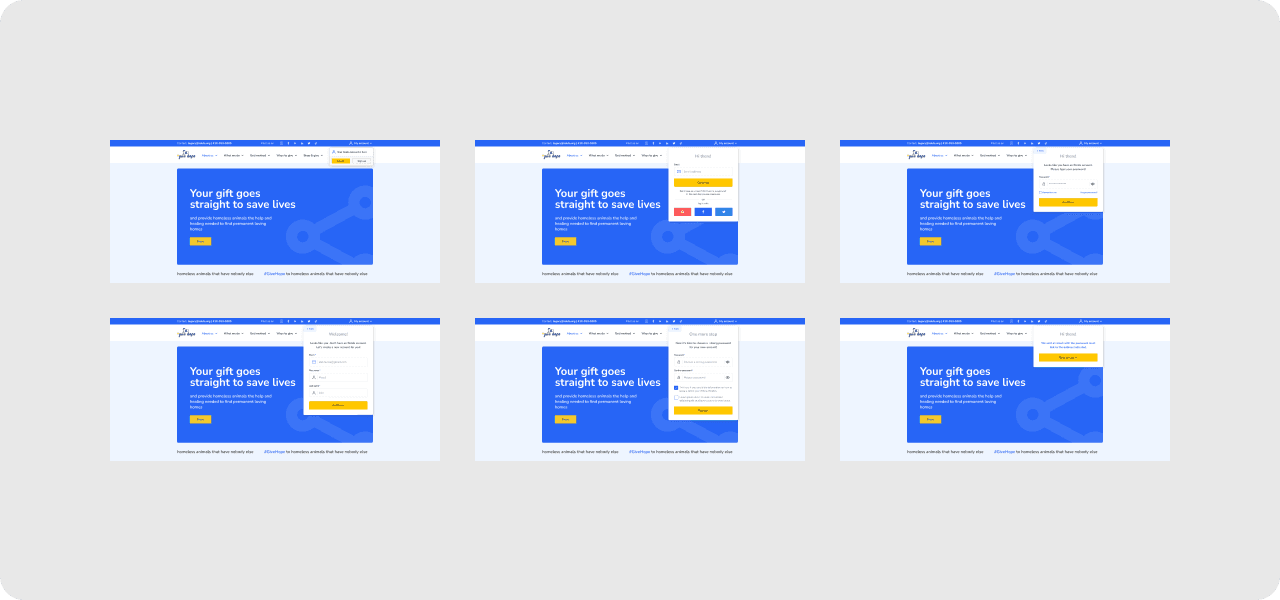
The next steps in the design process include conducting more design iterations for new pages and features. The field of fundraising is constantly evolving, remaining considerable potential for further improvements.
And it is exciting to be a part of this process and to have the opportunity to help street animals.